.avif)
Freevisuals
Pressing the spacebar and watching absolutely nothing happen, no playhead movement, no timecode change, no animation, is one of the more disorienting problems After Effects can throw at you, largely because the underlying cause is rarely obvious from the symptom alone. Understanding how RAM Preview actually works, and working through the genuine range of possible causes systematically, resolves this considerably faster than repeatedly mashing the spacebar hoping something changes.
After Effects does not play back a composition directly the way traditional editing software does, instead relying on RAM Preview to pre-load frames into memory first, and this process can fail for several genuinely distinct reasons. This post covers how RAM Preview actually works, insufficient RAM and disk cache issues, playback resolution and skip frame settings, a genuinely surprising audio hardware cause involving Bluetooth devices, corrupted preferences, outdated software, and even a malfunctioning keyboard as real, confirmed culprits. It also includes a real video walkthrough and frequently asked questions.
By Jack Wright, Founder, Freevisuals. Updated 2026.
Unlike traditional editing software that plays footage directly, After Effects relies on a process called RAM Preview specifically because compositions frequently involve considerable real time processing, layered effects, blending modes, and 3D elements, that cannot be calculated fast enough to play smoothly without first being rendered into memory. Pressing the numeric zero key, or clicking the RAM Preview button directly, begins this process, visibly represented by a green bar progressively filling in across your timeline as frames load into your computer's available RAM. Once this green bar covers your intended preview range, pressing spacebar plays that pre-loaded section back smoothly in real time.
Understanding this distinction matters considerably for troubleshooting, since a genuinely empty or barely progressing green bar points toward a RAM or processing related cause, while a fully green bar that still refuses to play when spacebar is pressed points toward a completely different category of issue entirely, more likely related to your actual playback trigger or audio configuration rather than memory itself.
The single most common cause behind failed or extremely short RAM Preview sessions is genuinely insufficient available memory. After Effects' own recommended minimum sits around eight gigabytes of RAM, though sixteen gigabytes or more is considerably more realistic for smoothly previewing typical HD projects, and demanding 4K or heavily layered compositions benefit from even more. Purging your current RAM cache through Edit, then Purge, then All Memory, clears out accumulated temporary preview data and frequently resolves an immediate playback failure, particularly if your system has been running After Effects for an extended session without a fresh cache clear.
Adjusting how much RAM After Effects reserves for other applications, found through Edit, then Preferences, then Memory, and lowering this reserved amount, frees up additional memory specifically for After Effects itself, worth adjusting particularly on systems where you are not simultaneously running other genuinely RAM intensive applications alongside it.
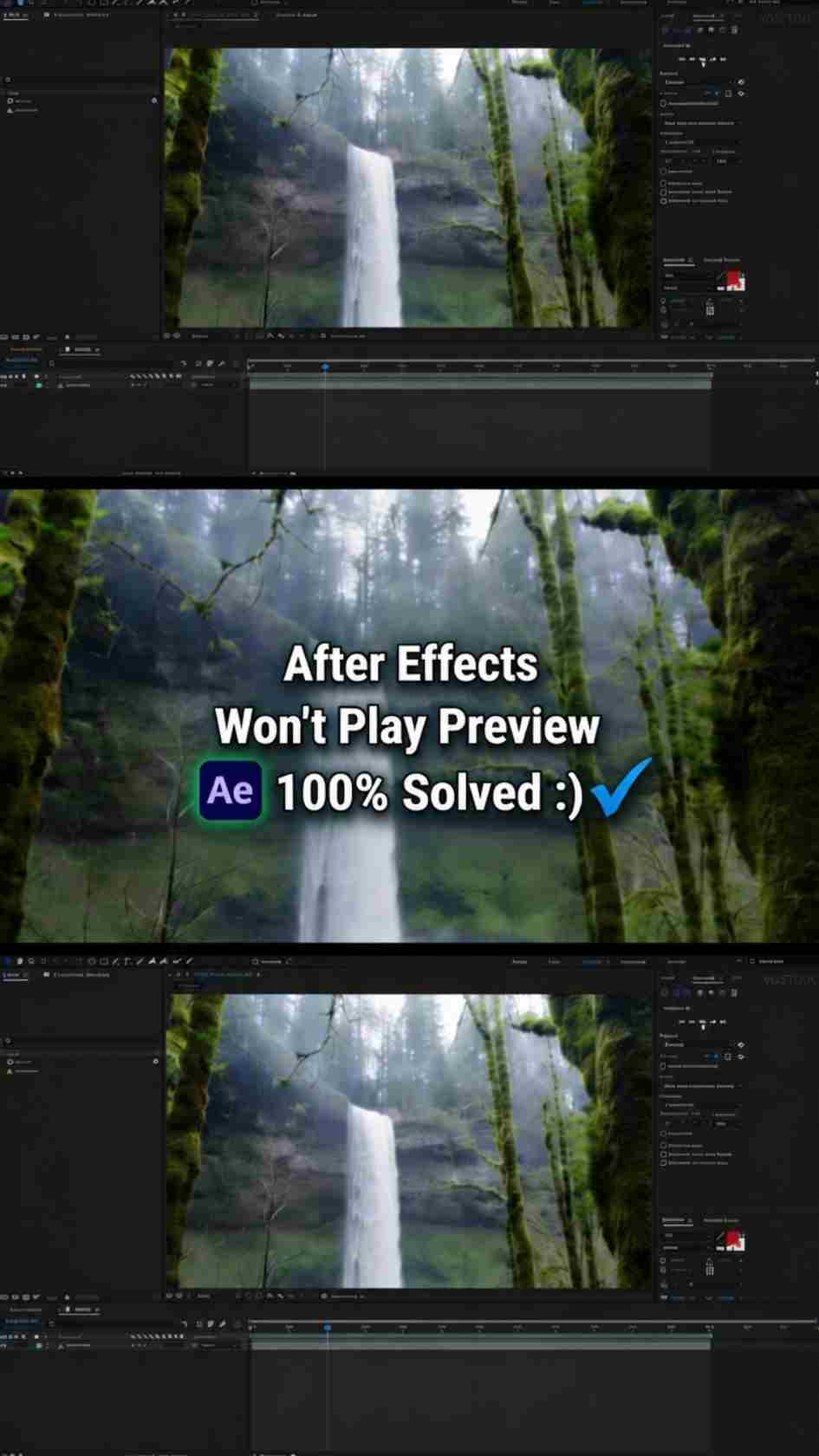
This video explains how to fix an issue in Adobe After Effects where the preview video won't play. It likely walks through common causes, such as preview settings, cache problems, RAM allocation, GPU acceleration, or composition settings and demonstrates steps to restore normal playback performance.
Beyond raw memory availability, your specific resolution and skip frame settings directly affect how much processing RAM Preview actually requires. Reducing your Playback Resolution from the default Auto setting down to Half, Third, or Quarter, adjustable through the dropdown at the bottom of your Composition panel, dramatically reduces both the RAM and disk cache demand of previewing your composition, at the cost of a visibly softer, lower quality preview image during playback specifically, without affecting your actual final render quality at all. Separately, confirming your Skip drop-down within the Preview panel is genuinely set to zero, rather than accidentally configured to skip frames, ensures you are not inadvertently working against yourself with a setting that should be helping performance but has been misconfigured.
It is also worth knowing that After Effects distinguishes between a pause resolution, controlled through the Composition panel's own resolution dropdown, and a separate play resolution, controlled through the Preview panel specifically, meaning these two related but genuinely distinct settings sometimes need to be checked and adjusted independently of one another.
One of the more surprising, but genuinely well documented, causes behind a stuck or completely non functional RAM Preview involves your system's current audio output device specifically, particularly Bluetooth headphones or speakers. Multiple editors have reported RAM Preview refusing to play entirely while a Bluetooth audio device was set as their active output, with switching back to standard wired speakers resolving the issue immediately and completely. Checking Preferences, then Audio Hardware, and confirming your Default Output device is correctly configured, ideally to a standard, wired audio output rather than a wireless device, is worth testing specifically if more conventional RAM and resolution related fixes have not resolved your specific playback failure.
Corrupted preference files can produce playback failures alongside a wide range of other unrelated seeming issues. Resetting your preferences involves closing After Effects entirely, then reopening it while immediately holding Ctrl plus Alt plus Shift on Windows, which prompts a dialog asking whether you want to delete your current preferences file. Confirming this reset generates a fresh, uncorrupted set of default preferences, and since this only affects application settings rather than your actual project content, it remains a genuinely low risk troubleshooting step worth trying relatively early in your diagnostic process.
Running an outdated version of After Effects occasionally means you are experiencing a playback bug Adobe has already identified and resolved in a subsequent release. Checking for updates directly through Help, then Check For Updates, ensures you are working with the most current, genuinely stable version available. For situations where a newer update itself appears to have introduced a new playback problem rather than resolving one, Creative Cloud's version management lets you roll back to a previous, known working version instead, a useful option specifically when a recent update correlates directly with when your playback issues first began.
Other applications running simultaneously, even ones you are not actively using, consume RAM and processing resources that After Effects could otherwise be using for its own RAM Preview process. Closing genuinely unnecessary background applications, other Adobe programs like Premiere Pro or Audition, web browsers, music streaming applications, before attempting a RAM Preview frees up meaningfully more system resources specifically for After Effects. On Windows, Ctrl plus Shift plus Escape opens Task Manager directly for closing these background applications, while on Mac, Option plus Command plus Escape opens Force Quit for the same purpose.
Occasionally the actual cause has nothing to do with After Effects at all, a malfunctioning spacebar or keyboard specifically. If your spacebar seems unresponsive specifically within After Effects, testing whether it responds correctly in other applications helps rule this out quickly, and connecting a different keyboard entirely provides a definitive test. If a different keyboard resolves the issue immediately, you have found your actual cause without needing to pursue any further software related troubleshooting at all. As an alternative playback trigger regardless of the underlying cause, using Composition, then Preview, then Play Current Video from the menu bar plays your composition without depending on the spacebar shortcut at all.
When working with After Effects, it's essential to understand that it isn't like your typical video editing software. Instead of instantly playing back your composition when you hit the spacebar, After Effects requires something called a RAM Preview. This is a pre-render of your composition, allowing you to see it in real-time.
Procedure to Initiate a RAM Preview:
Think of RAM Preview as a chef tasting a dish before serving. The chef needs to ensure the flavors are right, and similarly, you need to ensure your animation or effect looks perfect.
Sometimes, external audio devices, like headphones, can interfere with After Effects playback. It's a bit like trying to listen to a song on a speaker with a loose wire; it might not play correctly.
Procedure to Check Audio Hardware:
It's a simple check, much like ensuring all cables are plugged in when your TV isn't showing a picture.
If you're pressing the spacebar and nothing's happening, there's another way to play your composition. The Composition Menu is like the control center of your project, and it offers multiple playback options.
Procedure to Play from Composition Menu:
Imagine the Composition Menu as the remote control for your TV. Even if one button doesn't work, there are other buttons that can perform the same function.
Believe it or not, sometimes the problem is as simple as a malfunctioning keyboard. If your spacebar isn't responsive in other applications, this could be the culprit.
Solution: Try connecting a different keyboard to your computer and test the spacebar in After Effects. If it works, you've found the issue. It's like replacing batteries in a remote; sometimes the simplest solution is the right one.
Preferences in After Effects store your customized settings. However, if they become corrupted, they can cause issues, including playback problems.
Procedure to Reset Preferences:
This process is akin to resetting your phone settings when it starts behaving erratically. It gives you a fresh start.
Just like how our smartphones need updates to fix bugs and improve performance, After Effects also releases updates for the same reasons. If you're using an outdated version, you might encounter issues that have already been addressed in newer versions.
Solution: Regularly check for software updates. Go to the "Help" menu in After Effects and select "Check for Updates." It's like taking your car for regular maintenance checks to ensure smooth performance.
If your composition is heavy with multiple layers, effects, and high-resolution assets, your system might struggle to play it back in real-time. It's like trying to run a marathon with a heavy backpack; it slows you down.
Solution: Consider pre-rendering complex parts of your composition or temporarily turning off layers/effects to make playback smoother. It's like breaking a large task into smaller, manageable chunks.
The cache in After Effects stores temporary data to speed up tasks. However, if it's full or has old data, it can hinder performance.
Procedure to Clear Cache:
It's like clearing out old, unused apps on your phone to free up space and improve speed.
When you play your composition, you might notice a slight delay with a message saying "mixing audio for preview." This is After Effects processing your audio for playback.
Solution: If you haven't made changes to your audio, this shouldn't happen repeatedly. Check your audio settings and ensure they're optimized for your project. It's like ensuring the volume is set right before playing a song.
Other software running in the background can sometimes interfere with After Effects.
Solution: Close any unnecessary applications when working in After Effects. It ensures that all your computer's resources are focused on After Effects, much like closing all other books when studying a particular subject.
Your computer's hardware plays a crucial role in how well After Effects runs. If it doesn't meet the software's requirements, you'll face issues.
Solution: Check the official Adobe website for After Effects' hardware requirements. If your system falls short, consider upgrading. It's like ensuring you have the right tools for a job.
Sometimes, the issue isn't with After Effects but with the project file itself.
Solution: Try opening a different project. If it works fine, your original project might be corrupted. Consider importing its contents into a new project. It's like transferring your belongings to a new bag if the old one has a tear.
For particularly stubborn cases where RAM Preview only manages to render a single frame before stopping despite seemingly adequate available RAM, a genuinely unusual but repeatedly confirmed fix involves booting your computer into Safe Mode, opening and then immediately closing After Effects once while still in Safe Mode, and then rebooting normally afterward. Multiple editors across different hardware configurations have reported this specific sequence resolving an otherwise persistent, severely limited RAM Preview issue that standard troubleshooting steps failed to address, though the underlying reason this particular sequence works remains somewhat unclear even among those who have used it successfully.
It genuinely helps to understand how disk cache and RAM cache relate to one another, since confusing these two related but distinct systems can lead you toward the wrong specific fix. Disk cache refers to temporary rendered files stored on your hard drive, generated in the background as you work, while RAM cache refers specifically to the subset of that data actually loaded into your computer's active memory for real time playback. After Effects does not preview directly from disk cache, it loads relevant data from disk cache into RAM cache first, meaning a genuinely large, well populated disk cache does not automatically guarantee smooth RAM Preview if your available RAM itself is still the limiting factor.
For systems where storage space rather than RAM appears to be the more limiting factor, confirming your disk cache location points to a drive with genuinely adequate free space, and ideally a fast solid state drive rather than a slower traditional hard disk, meaningfully speeds up how quickly After Effects can populate this intermediate cache layer before that data becomes available for loading into RAM during an actual preview.
For editors who have genuinely worked through every software based fix covered in this guide and continue experiencing persistent RAM Preview limitations, it may simply be time to consider whether your current hardware meets the actual demands of your typical project workload. Reviewing Adobe's current recommended system specifications, rather than only the stated bare minimum, gives a more realistic sense of what genuinely smooth performance requires for your specific kind of work, particularly if you regularly work with 4K footage, heavily layered compositions, or extensive 3D elements that place considerably greater demand on available memory than simpler, more modest projects would.
A RAM upgrade specifically tends to offer the most direct, immediate improvement to RAM Preview performance for editors working near or beyond their system's current capacity, often providing a more meaningful practical improvement than a comparably priced upgrade to other components for this specific kind of playback related performance issue.
A frequent mistake involves assuming a single specific cause immediately, RAM limitations most commonly, without working through the other genuinely documented possibilities when that first fix does not resolve the issue. Another common error involves overlooking the audio hardware connection entirely, since it is genuinely counterintuitive that a video playback failure could trace back to an audio device setting, leading many editors to never even consider checking this specific cause despite how well documented it actually is across community reports.
A genuinely smooth, responsive editing workflow pairs naturally with the kind of considered, professional projects our own After Effects templates library is built around. Our free LUT library is also worth pairing with any project needing a consistent color treatment once your playback issues are resolved. For premium templates and additional creative assets, Motion Array and Envato are both worth exploring, and for properly licensed music, Artlist and Epidemic Sound both carry genuinely strong catalogues.
Beyond reactive troubleshooting once a specific playback issue has already appeared, building a light, regular maintenance routine around cache management and system resource awareness genuinely reduces how often these issues arise in the first place. Purging your RAM cache at natural break points throughout an editing session, rather than only once performance has already noticeably degraded, keeps After Effects working from a genuinely fresh, uncluttered memory state consistently rather than allowing accumulated cache to gradually compound into a more significant slowdown over an extended working session.
Similarly, periodically reviewing which background applications tend to remain open during your typical editing sessions, and closing the ones that are not genuinely necessary for your current task, builds a habit that compounds in value over time, since a computer consistently freed of unnecessary resource competition tends to maintain smoother RAM Preview performance across an entire project's duration rather than only immediately after a fresh restart.
The green bar represents your RAM Preview progress, showing which frames have successfully loaded into memory. A green bar that fills slowly or stops early points toward a RAM or processing related cause, while a fully green bar that still will not play points toward a different issue entirely.
Eight gigabytes is Adobe's stated minimum, but sixteen gigabytes or more is considerably more realistic for smoothly previewing typical HD projects, with demanding 4K or heavily layered work benefiting from even more available memory.
This is a genuinely documented, if not fully understood, issue where certain Bluetooth audio configurations interfere with RAM Preview functioning correctly. Switching to a standard wired audio output has resolved this for multiple editors experiencing an otherwise inexplicable playback failure.
No, playback resolution only affects what you see during preview and editing, never your actual final export quality, making it a genuinely safe adjustment to reach for whenever RAM Preview feels sluggish or fails to complete.
The Safe Mode boot sequence, opening and closing After Effects once while in Safe Mode before rebooting normally, has resolved otherwise persistent, severely limited RAM Preview issues for multiple editors when more conventional fixes did not help.
After Effects failing to play back a composition has a genuinely wide range of possible causes, from simple RAM limitations through to genuinely surprising culprits like Bluetooth audio devices or a malfunctioning keyboard. Working through these causes systematically, starting with the most common causes, insufficient RAM and unoptimized resolution settings, before moving toward the more unusual but genuinely confirmed fixes, resolves the overwhelming majority of playback failures without requiring a full reinstall or hardware upgrade of any kind.
Building a habit of purging cache regularly and keeping your specific playback resolution matched to your current stage of work, rather than only troubleshooting reactively once a problem has already appeared, helps prevent a genuine share of these issues from occurring in the first place, keeping your RAM Preview reliable across a typical busy editing session and letting you focus your actual attention on the creative work itself rather than repeated technical interruptions.
.avif)
.avif)
.avif)
.avif)