.avif)
Freevisuals
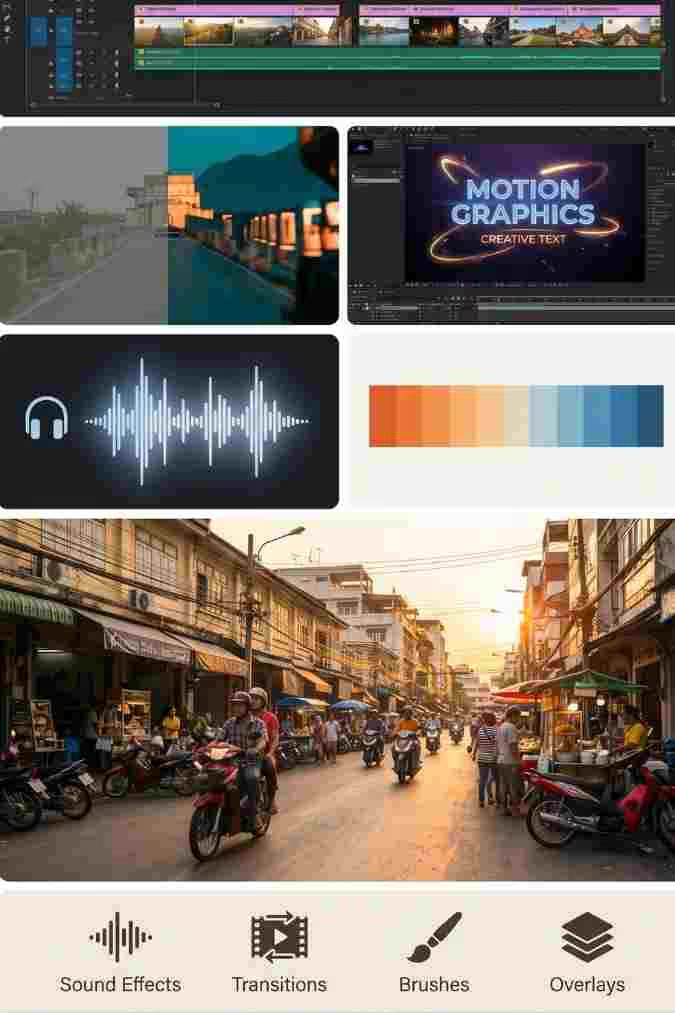

Evoke nostalgia with this Final Cut Pro film roll effect, mimicking classic cinema transitions, great for adding a vintage feel.
Download FREEGo Pro To DownloadDownload NOW!Most "retro film" templates look like a Photoshop filter slapped on a timeline. This one feels like you actually shot on celluloid. Here is why it has become one of my most-reached-for assets in the edit suite.
I have been editing video professionally for over a decade. In that time I have downloaded more transition packs than I care to admit, and the graveyard of barely-used assets on my drives would give any storage engineer nightmares. So when I say the Artlist Film Roll Transitions template for Final Cut Pro is genuinely worth your time and money, I mean it in the most caffeinated, post-midnight-edit kind of way.
Created by motion graphics designer Animark and available through Artlist, this template replicates the physical sensation of 35mm film advancing through a projector gate. We are talking visible sprocket holes, film grain that breathes rather than tiles, light leak halos in the corners, and a warm, slightly washed colour grade baked into the transition itself. Not a dozen filters stacked on top of each other. Just one cohesive, analog-feeling motion that takes your edit from one clip to the next in a way that feels earned rather than forced.

The template file ships as an Artlist download and installs directly into Final Cut Pro via a simple drag-and-drop into your Motion Templates folder. No FxFactory, no third-party plugin manager, no command line. The compatibility listed on the product page is Adobe Premiere Pro 2020, so if you are working exclusively in Final Cut Pro, confirm the file format before downloading to ensure you have the correct version for your workflow.
What you get is a pack of film roll transition animations in both 4K and HD resolution. Each transition features the core visual language of analog film: the unmistakable sprocket-hole frame border, a realistic tape texture that catches and scuffs the light, organic light leaks that pulse rather than strobe, and a filmic grain layer that sits on top of your footage in a way that suggests the grain was always there rather than being added in post.
The tags on the Artlist product page describe it accurately: camera, vintage, retro, old, tape, leaks, cinematic, frame. That is not marketing copy. That is a faithful description of what you are getting.
The best transition is the one your audience does not consciously notice but absolutely feels. This template gets that balance right.
If you are new to installing Artlist templates in Final Cut Pro, the process is straightforward once you know where things live.
If Final Cut Pro does not immediately show the template, quit and relaunch the application. It indexes the Motion Templates folder on startup.
Here a thorough walkthrough of everything you need to know about transitions in Final Cut Pro, from the basics of dragging and dropping to more advanced customisation. Worth watching before you start working with any custom template so you know exactly how to control timing, duration and placement in your timeline.
Let me be blunt about what separates a great film-roll template from a mediocre one, because the market is saturated with both. The mediocre ones use flat, tiled grain textures that look identical whether they are sitting over a daytime exterior or a dark interior. They use hard-edged frame borders that feel digital. And the light leaks tend to be symmetrical, which no analog light leak ever is.
Animark's approach is different. The grain on this template responds to the luminance of the underlying footage because of how the blend mode is constructed. In bright areas it is nearly invisible. In shadows it gathers and clusters in a way that genuinely mimics silver halide. The frame edges have a slight fringing, as though the film gate itself has microscopic imperfections. And the light leaks originate from a corner or edge and bloom inward, which is how they actually behave when light strikes unexposed film.
These are small things on paper. In a finished edit, they are the difference between footage that looks like it was treated with a filter and footage that looks like it was actually shot on a different era of camera. The latter is what you are paying for with a quality template library like Artlist, and this one delivers it.
Here is another clear, practical breakdown videos of how to build a vintage film look from scratch inside Final Cut Pro X using free assets. This is excellent context for understanding what the Artlist Film Roll template is doing under the hood, and it gives you ideas for pushing the aesthetic further across your whole sequence beyond just the transitions.
The warm, nostalgic quality of the film roll transition is a natural fit for travel content. It suggests memory, passage of time, and the romance of being somewhere unfamiliar. If you are cutting a highlights reel from a trip, placing a film roll transition between location changes rather than between individual shots within a location creates a pacing rhythm that feels intentional rather than decorative.
Film aesthetics and wedding cinematography have been intertwined for years because of what both represent: moments that feel unrepeatable and precious. A film roll transition between ceremony and reception, or between the getting-ready sequence and first look, adds a sense of emotional weight to the edit without being heavy-handed about it.
If you are cutting to a song with a lo-fi, indie, or folk sensibility, this transition is an obvious companion. It also works well in short films where you want to signal a time-jump or a shift in emotional register without resorting to a title card or a hard cut to black.
Not all Instagram Reels and TikTok content needs to be fast-cut and saturated. There is a growing appetite for slower, more atmospheric short-form video, especially in the travel, lifestyle, and food spaces. Film roll transitions give that kind of content an immediate texture and mood without requiring any complex grading work on your end.
Transitions do not exist in a vacuum. The most effective use of the Film Roll template is as part of a broader creative toolkit where every element is pulling in the same aesthetic direction. Here is what I pair with this template on a regular basis.
Use them sparingly. Three or four film roll transitions in a four-minute travel film is powerful. Fourteen of them is exhausting. The analog aesthetic depends on feeling special and deliberate, not wallpapered across the entire edit.
Match your cut to a musical moment. The most effective placements are on a downbeat, a chord change, or a breath in the vocal. The mechanical quality of the film rolling through the gate has its own internal rhythm, and it plays best when it has a musical partner to lock into.
Grade your footage first, then apply the transition. If you apply the transition to ungraded, log-gamma footage, the light leaks will interact with a very different luminance profile than if the footage has already been brought to its final look. Grade first, then layer the transition on top for a much more cohesive result.
Adjust the duration to match your pacing. A travel vlog shot at 30fps with quick cuts wants a shorter transition, somewhere around 12 to 18 frames. A cinematic short film shot at 24fps with longer, more contemplative takes can afford 24 to 30 frames. There is no universal answer, only what serves the edit.
Honestly, not for one template alone. But that is also not really what Artlist is. An Artlist subscription gives you access to their entire catalogue of royalty-free music, sound effects, stock footage, AI tools and video templates under a single commercial licence. If you are making video content for clients, YouTube or social media on a regular basis, the maths work out very quickly. The Film Roll Transitions template is one of dozens of high-quality FCPX templates in the library, and every piece of music you add to your timeline is covered without per-video sync licensing.
If you are not yet ready to commit to Artlist, Envato Elements is an alternative that covers a similarly broad range of Final Cut Pro templates, LUTs and creative assets under an unlimited subscription model. For music specifically, Epidemic Sound remains one of the most generous catalogues available at its price point, with outstanding vintage and cinematic playlists that pair directly with the film aesthetic we are building here. For stock footage, Shutterstock gives you access to a massive library of premium clips, including archival and vintage material, that can round out any project where your own camera footage needs supplementing.
What is the Artlist Film Roll Transitions template for Final Cut Pro?
It is a professional video template created by Animark and available through Artlist. It simulates the look of physical 35mm film advancing through a projector gate, complete with frame edges, light leaks, tape textures and grain overlays. Available in 4K and HD with no third-party plugins required.
Does the Film Roll Transitions template require any plugins?
No. The template is completely self-contained and works natively within Final Cut Pro once the template file is placed in your Motion Templates folder. There is no FxFactory or other plugin manager required.
What kind of video projects is this transition best suited to?
The Film Roll Transitions template works particularly well for travel films, wedding videography, music videos, short films, lifestyle content and any project where you want to evoke the warmth and texture of analog celluloid. It is less suited to corporate explainer videos or fast-paced commercial content where a cleaner aesthetic is expected.
Can I use Artlist templates and music commercially?
Yes. An active Artlist subscription covers commercial use across YouTube, Instagram, Vimeo, broadcast and client work. Their licensing model means you do not need to relicense when a client redistributes a video you edited for them. Always verify your specific plan tier covers the usage you need.
What music works best alongside film roll transitions?
Warm acoustic tracks, lo-fi piano, cinematic folk, dusty brass and vintage jazz all complement the analog aesthetic naturally. Both Artlist and Epidemic Sound have curated playlists specifically for cinematic and vintage moods that are worth exploring when searching for the right track.
How long should a film roll transition be in the timeline?
For most projects, somewhere between 18 and 28 frames at 24fps feels authentic. Shorter than 12 frames and the mechanical quality of the roll gets lost. Longer than 36 frames and it starts to feel indulgent unless the surrounding edit is very slow and contemplative. Adjust based on your specific footage and musical pacing.
Are there free alternatives to the Artlist Film Roll Transitions?
There are free film grain overlays and basic light leak clips available on sites including Mixkit and here on Freevisuals. However, a purpose-built transition template that combines frame elements, grain, light leaks and timing in a single motion asset is a different level of quality and consistency. The free alternatives require more manual assembly and grading work to achieve a comparable result.
I have used a lot of transition templates over the years, and most of them end up abandoned after two or three projects because they only work in a narrow set of circumstances. The Artlist Film Roll Transitions template is one of the rare ones that has stayed in my regular rotation because the underlying aesthetic is genuinely useful across a wide range of project types, and because the quality of the motion design is high enough that it does not draw attention to itself in a bad way.
If you are already on an Artlist subscription, downloading this template is a no-brainer. If you are not yet on Artlist and you make regular video content, the subscription pays for itself very quickly once you factor in the music and footage licences alongside the template access.
The film aesthetic is not going anywhere. There is something fundamentally human about the warmth and imperfection of analog photography and filmmaking, and audiences respond to it even when they cannot name what they are responding to. A template like this one gives you a reliable, high-quality shortcut to that feeling without requiring you to shoot on actual film or spend hours grading in DaVinci Resolve.
Use it well, use it deliberately, and it will earn its place in your toolkit.
Disclosure: Some links in this article are affiliate links. If you click through and purchase a subscription, Freevisuals earns a small commission at no extra cost to you. This keeps the site running and allows us to keep reviewing tools honestly. All opinions are entirely our own.
Download free video templates, LUTs, and presets for Premiere Pro, After Effects, DaVinci Resolve, CapCut, and Final Cut Pro.

%20Profile%20Pic.jpg)