.avif)
Freevisuals
Free AI ancient civilisations video prompt pack. 8 image and video prompts to generate a 71-second lost city rise and fall sequence. Works with Midjourney
Download FREEGo Pro To DownloadDownload NOW!History and documentary content is one of the most profitable niches on YouTube right now. Faceless storytelling channels command $15 to $25 CPM, and more than half of new YouTube creators entering the platform in 2025 are using AI tools to launch faceless channels - with history, educational content, and world civilisations among the most successful niches. The problem every history creator hits immediately is footage. You cannot film the Roman Colosseum at its peak. You cannot capture Petra the day it was first carved. You cannot show the moment a city was abandoned to the jungle a thousand years ago. Until now those moments simply did not exist on screen.
This free download gives you a complete prompt sequence to generate exactly those moments. 8 image prompts taking a single fictional ancient temple complex from its peak of glory through centuries of decline, jungle reclamation, archaeological discovery, and finally its modern heritage site state. Each image is then animated using the matching video prompt to create a cinematic clip. Assembled in sequence with cross-dissolves and narration, you have a complete 71-second documentary-quality sequence showing the full arc of an ancient civilisation.
The narration structure is included in the download file. The colour grading arc is mapped out shot by shot. The suggested transition timings follow professional documentary editing conventions. This is not just a prompt pack. It is a complete production package for history YouTube creators.
Download the full Ancient Civilisations AI Video Prompt Pack free from Freevisuals here
The top 10 most profitable YouTube niches include faceless storytelling at $15 to $25 CPM, educational explainers at $10 to $25 CPM, and ancient philosophy channels earning $2,000 to $4,000 per month on 500,000 to 700,000 monthly views. These numbers are driven by the fact that the audiences for history, ancient civilisations, and educational documentary content are highly engaged and advertiser-friendly.
The creators winning in this space have two things that most others do not: a consistent visual aesthetic and footage that no stock library can provide. Historical content that blends education with cinematic visuals attracts history enthusiasts and general audiences alike, and the niche remains far less saturated than gaming or lifestyle despite its strong CPM performance.
The visual problem is real and consistent. A creator making a video about the fall of the Maya civilisation needs footage of Maya cities at their peak, their decline, and their modern ruined state. Stock libraries have modern photographs of Chichen Itza. They do not have footage of it as a living city filled with people. AI generation is the first tool that can produce this footage, but only if the prompts are structured correctly for the specific narrative arc of a rise-and-fall story. That is exactly what this pack provides.
The fictional site in this pack is an intentional design decision. By creating a temple complex that draws on the visual vocabulary of Angkor Wat, Petra, Palenque, and Palmyra without depicting any of them specifically, every piece of generated footage is usable without any risk of historical accuracy criticism. The visual language says ancient civilisation. The specific details are yours to fill with whichever civilisation your content covers.
The other packs in this series, the city timelapse, the storm sequence, and the cozy bookshop, all use the anchor-and-variation method to show the same physical space changing through time or weather. This pack uses the same method but for a fundamentally different purpose: to show the passage of centuries rather than hours.
That creates some differences in how the pack is structured. The similarity slider is set at 60 to 70 percent rather than the 70 to 78 percent of the bookshop pack, because the changes between shots are more fundamental. A bookshop interior at Christmas and the same interior in October should look almost identical except for a few details. An ancient temple at its peak and the same temple consumed by jungle after 800 years should look dramatically different while still being recognisably the same architectural structure. The lower similarity setting gives the AI more creative freedom to develop the decay and vegetation while maintaining the core architectural reference.
The transition timing is also more deliberate than other packs. The 4-second dissolve between Shots 04 and 05, the abandonment and the jungle reclamation, is the longest transition in the sequence and it is placed at the single biggest time jump: from a recently abandoned city to a fully jungle-consumed ruin. A long slow dissolve at that point communicates the passage of centuries more effectively than any text caption. The viewer feels the time passing in the slowness of the transition itself.
For image generation, Midjourney v7 produces the strongest results for architectural grandeur and ancient stone aesthetics. The lighting treatment for the golden hour peak shots and the dappled jungle light of the decay shots are areas where Midjourney's training data is particularly rich. Add --ar 16:9 --v 7 --style raw --q 2 to every prompt.
OpenArt AI is the recommended alternative on its SDXL or Realistic Vision model. Upload Shot 01 as the reference for all variations and set Image Strength to 0.60 to 0.70. The variation between shots in this pack is more dramatic than in the bookshop or city packs, so the lower similarity setting is important.
Magnific is more strongly recommended for this pack than for any other in the series. Ancient stone surfaces, carved relief sculptures, jungle vegetation consuming architecture, and weathered limestone texture are precisely the kinds of high-detail content where Magnific's enhancement pass produces its most dramatic quality improvement. The difference between a generated ancient temple image and the same image after a Magnific pass is the difference between footage that looks like an AI illustration and footage that looks like it belongs in a Netflix documentary. The carved relief detail, individual stone block texture, and vegetation density all benefit enormously. Run every key shot through Magnific before animating.
For video animation, Google Veo 3 is the recommended primary tool for the most important shots, specifically Shot 01 (the peak, maximum detail and crowd movement), Shot 05 (the jungle reclamation, complex vegetation motion), and Shot 08 (the golden hour heritage site, the emotional close). Kling AI handles the architectural and atmospheric shots cleanly and is the practical choice for the full sequence. Runway Gen-4 is the best option for the dawn mist shot (Shot 02) where atmospheric motion control is the priority.
For a full step-by-step tutorial on creating history documentary videos using AI tools including Leonardo AI and ElevenLabs for the complete production workflow: How to CREATE HISTORY Videos with AI: Full Tutorial.
For a complete guide to creating viral historical documentary content with AI including scripting, voiceover, and video generation for a faceless YouTube channel: Create VIRAL History Videos (Faceless and AI only): Step-by-Step Guide.
Understanding what each shot is doing in the story is as important as knowing what it should look like. This sequence is not just eight pretty images of an ancient site. It is a complete documentary narrative about the arc of human achievement.
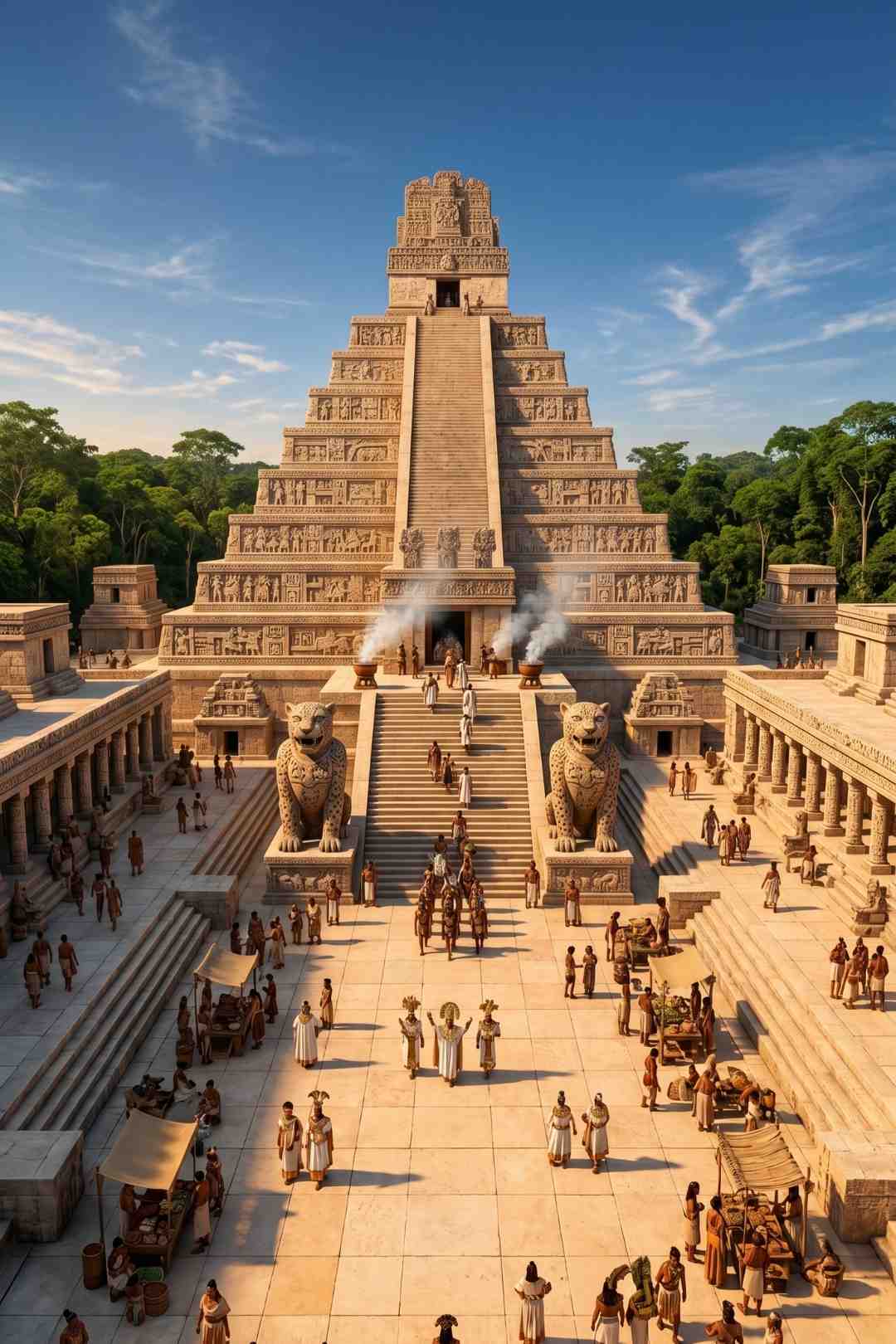
The anchor image and the emotional standard against which every subsequent shot is measured. A magnificent ancient temple complex at golden hour, filled with people, immaculately maintained, at the absolute height of its power and beauty. Every detail here establishes what will be lost: the carved reliefs, the ceremonial processions, the incense smoke, the pale limestone glowing amber in the afternoon sun. The more visually rich and alive this shot is, the more powerful the contrast with the abandonment and ruin shots will be.
Generate this image at the highest resolution available and run it through Magnific before using it as the reference for all subsequent shots. The quality of the anchor image determines the quality ceiling for the entire sequence.
The same complex at dawn, a hundred years later, still at the height of its power. The dawn mist and the small processional group of priests ascending the stairs in the pale golden light gives this shot a sacred, eternal quality that the busier peak shot does not have. This is the shot that makes the viewer feel that this civilisation seems indestructible. Which makes what follows more powerful.
The dawn light version also solves a practical problem: by showing the same site in two different lighting conditions in the first two shots, the viewer's visual understanding of the architectural layout is reinforced before the decay shots begin changing it.
The first sign that something is wrong. Gaps in the stone paving. A partially collapsed shrine building. Scrub plants beginning to grow in the cracks. Fewer people in the plaza. The central pyramid still standing, but the carved reliefs on its upper tiers showing gaps where stone has fallen or been removed. The overcast sky is the key atmospheric signal. After two shots of warm golden light, the flat neutral light of Shot 03 communicates that the warmth of that golden age is passing.
The video prompt for this shot specifies that the few figures in the plaza move without purpose, contrasting directly with the purposeful ceremonial procession of Shot 01. That detail, combined with a single piece of carved stone settling in the middle distance, does more narrative work than any text caption.
No people. Anywhere. The most emotionally powerful shot in the first half of the sequence. The late afternoon golden light returns here deliberately, mirroring the lighting of Shot 01 but now falling on an empty space. The same light that illuminated a city full of life now illuminates its absence.
The video prompt for this shot specifies a completely locked-off camera with the only motion being a single bird landing on one of the guardian figures and then flying away. That single bird, landing on the shoulder of a carved guardian that was built to protect a living city, is the most emotionally specific moment in the entire sequence. Generate multiple variations of this clip and select the one where the bird appears most naturally.
The biggest visual change in the sequence and the shot that benefits most from Magnific enhancement. The former ceremonial plaza is no longer a separate space, consumed entirely by jungle undergrowth. The smaller shrine buildings are rubble. Only the central pyramid still rises above the canopy, its lower half covered in vegetation.
The transition from Shot 04 to Shot 05 uses the pack's longest dissolve at 4 seconds. A viewer watching the sequence will feel the time passing in the slowness of that transition. This is the most important single editorial decision in the whole pack.
Centuries deeper into the abandonment. The site is not just overgrown but genuinely consumed. Tree roots grip the ancient stone. The architectural layout is visible only through the unnatural straightness of some stone edges emerging from the undergrowth. The pyramid itself is dark ancient limestone covered in centuries of moss. Morning mist. The site has not been visited by any human in hundreds of years.
This is the shot where the scale of the passage of time becomes visceral rather than just visual.
The abrupt cut back to the modern world. Cleared archaeological paths. Temporary marker stakes. Scaffolding on one face of the partially excavated pyramid. The carved reliefs newly revealed after a thousand years catching shafts of afternoon sunlight. The transition from Shot 06 to Shot 07 uses a shorter 2-second dissolve because the jump to the modern discovery moment should feel like an interruption of the long slow passage of centuries, not a continuation of it.
This is the shot where the narration typically delivers the discovery date and the name of the survey team or archaeologist. It is the pivot point from past to present.
The emotional close. The same warm amber golden hour light as Shot 01 now falls on the partially restored ancient stone. The pale limestone glows exactly as it did a thousand years earlier. Small silhouetted visitor figures stand at the base of the main staircase looking up at the carved guardian figures. The camera makes a very slow push forward as if the viewer too is approaching across a thousand years of time.
The parallel between Shot 01 and Shot 08, the same amber light, the same architectural centrepiece, the same guardian figures, but a thousand years apart and a civilisation's rise and fall between them, is the emotional centrepiece of the entire sequence. This is the moment the narration delivers its closing line.
The download file includes suggested narration lines matched to the timing of each shot. These are written as starter points rather than scripts:
Shot 01 establishes the scale of the civilisation. Shot 02 establishes its spiritual dimension. Shot 03 introduces the first hint of what is coming. Shot 04 delivers the abandonment as a fact without explanation. Shot 05 gives the jungle its agency in the story. Shot 06 emphasises the depth of the forgetting. Shot 07 delivers the discovery as a dramatic event. Shot 08 closes with a reflection on what civilisations achieve and what they lose.
The deliberate withholding of explanation in Shot 04 (the last inhabitants left without explanation) is the narrative choice that makes the sequence emotionally compelling for an audience. The mystery of why the city was abandoned is more powerful than any explanation because it implicates the viewer in the same question that has occupied archaeologists for generations.
For AI voiceover generation to match the authoritative documentary tone this narration requires, ElevenLabs is the recommended tool. The narrative documentary voice styles in ElevenLabs produce the kind of measured, authoritative narration that viewers associate with BBC and Netflix documentary production. For a history channel building a consistent channel voice, select one ElevenLabs voice for this sequence and use it as your channel's permanent narrator voice across all content. Viewer association with a specific voice builds channel identity in the same way a presenter's face does for on-camera channels.
The colour grade is where the emotional arc of the sequence becomes visually coherent rather than just a series of individual images.
The Free Mega Cinematic LUT Pack on Freevisuals provides the base grade. Apply a warm cinematic LUT at full opacity to Shots 01, 02, and 08 to maximise the golden amber quality of the peak and the heritage site shots. Reduce LUT opacity to 60 to 70 percent on Shots 03 and 04 and add a slight cool shift using the colour temperature control in your editing tool. For Shots 05 and 06 pull the colour temperature noticeably cooler and slightly toward green to enhance the jungle light quality. For Shot 07 bring the warmth partially back, matching the partial restoration of warmth as the modern discovery happens.
The full grade arc follows the emotional arc: warm and saturated at the peak, cooling through the decline and abandonment, going distinctly green-tonal through the jungle reclamation, and returning to warm amber in the final heritage site shot that mirrors the opening.
In DaVinci Resolve, apply the global LUT at the timeline level and then create individual clip adjustments using nodes above the LUT to add the colour temperature shifts per shot without affecting the base grade. In Premiere Pro, apply the LUT via a Lumetri Color adjustment layer and then add secondary Lumetri effects to individual clips for the per-shot adjustments.
This sequence needs music that builds gradually, carries emotional weight, and does not resolve. The emotional arc from a civilisation at its peak to its eventual loss and rediscovery is one of the most powerful narrative shapes in human storytelling and the music needs to honour that without becoming melodramatic.
Prompt 01 from the Freevisuals AI Background Music Prompt Pack generates a slow-building orchestral tension track with no melody for the first 30 seconds that maps well to the opening two shots. The absence of melody in the first half of the sequence lets the visuals and narration carry the emotional weight without musical interpretation competing with them.
For a professionally licensed orchestral score with the depth this sequence deserves, Artlist has a dedicated ancient world and cinematic history category with downloadable stems. The stems are particularly valuable here because you want to be able to reduce the orchestral arrangement during the narration sections and bring it back to full during the visual-only moments. A single annual licence covers all commercial YouTube use.
Epidemic Sound has strong cinematic documentary tracks that suit this content type with the per-channel YouTube registration covering all uploads retroactively once you register your channel.
A 71-second ancient civilisation sequence has more applications than just a standalone video asset.
As a channel intro for a history or documentary YouTube channel, the heritage site shots (07 and 08) combined with the peak shots (01 and 02) make a powerful 20-second intro without needing the full decay sequence. As b-roll footage within a longer history video, individual clips from the sequence serve as establishing shots for any ancient world content regardless of the specific civilisation being discussed. The fictional site's visual vocabulary is broad enough to work as a visual backdrop for content about the Maya, the Khmer Empire, Palmyra, or any other ancient urban civilisation.
For short-form repurposing, Shot 01 (the peak) and Shot 08 (the golden hour heritage site) are the two strongest standalone clips. The contrast between them, the same architectural setting a thousand years apart, is immediately compelling as a Reel or Short with a text overlay posing the question: "What happened in between?" That curiosity gap is one of the most reliable click and scroll-stopping mechanisms in short-form content.
InVideo handles the reformat from 16:9 to 9:16 cleanly and its auto-caption feature works well for adding narration text to the vertical cut. CapCut is the faster option for TikTok with its built-in historical filter presets that complement the cinematic grade already applied to the footage. Filmora handles the full sequence editing and colour grading cleanly with its LUT import feature working directly with the Freevisuals LUT pack files.
The opposite. By using a fictional site that draws on the visual vocabulary of multiple real ancient civilisations without depicting any one specifically, you have footage that works as a visual backdrop for content about any ancient urban civilisation. A real Angkor Wat sequence only works for Angkor Wat content. This fictional temple complex works for Maya, Khmer, Roman, Mesopotamian, Egyptian, or any other ancient urban civilisation content. The visual language of monumental stone architecture, carved reliefs, and jungle reclamation is broadly readable as ancient civilisation across all audiences.
For documentary-style content with narration, the visuals serve as emotional backdrop rather than historical evidence. Viewers understand that AI-generated footage of an ancient city is a reconstruction or illustration, not archival footage. The most successful AI history channels are transparent about using AI-generated visuals, which actually increases viewer trust rather than reducing it, because the creator is being honest about the production method. Disclose in your video description that visuals are AI-generated reconstructions and include that information in the first 30 seconds of your video.
Shot 01, the anchor image, and Shot 08, the golden hour close. Shot 01 because its quality determines the quality ceiling for every subsequent variation. Shot 08 because it is the emotional climax of the sequence and the frame most likely to be used as the video thumbnail. Generate five or more variations of each and select the best. For Shot 08 specifically, the quality to look for is the warm amber light on the pale limestone matching the warmth of Shot 01. When that parallel lighting is present the sequence achieves its full emotional impact.
Write your narration first, then time each line against the clip duration. Each clip in this sequence is 8 to 10 seconds, which gives you room for one to two sentences of narration per shot. Record or generate your narration with ElevenLabs at a measured pace with natural pauses between sentences. Import the narration into your timeline first, then time your visual cuts to the natural pauses in the narration rather than cutting to a fixed clock. Documentary editors almost always cut to the rhythm of the narration rather than the other way around.
Yes. The most effective approach is to use a single shot rather than the full sequence for Shorts. Shot 05 (The Jungle Reclaims) animated with the video prompt produces one of the most visually distinctive clips in the pack: an active jungle environment growing over ancient stone. With a text overlay posing a historical question (What happened to the people who built this?) that clip performs strongly as a Shorts curiosity hook. Shot 06 (Deep Jungle Ruin) with a similar text overlay also works well. For Shorts using the animated clips, CapCut handles the vertical reformat most efficiently.
Run these shots through Magnific before animating them. Jungle vegetation is one of the most detail-rich environments that current AI image generators produce less convincingly than other environments, primarily because of the complexity of light through canopy, the density of overlapping foliage, and the texture of moss and lichen on stone. A Magnific enhancement pass adds exactly the kind of organic detail complexity that makes jungle-and-ruin footage look genuinely naturalistic rather than synthesised. The difference in the Stone 05 and 06 images after Magnific is more dramatic than for any other shot type in this series.
The ancient civilisations pack is the most narratively ambitious release in the Freevisuals AI prompt series. It sits alongside a library of packs that together cover the full range of cinematic AI video content creation.
The City at Different Times of Day AI Prompt Pack takes a modern urban rooftop through a complete 24-hour cycle, from pre-dawn through golden sunrise, midday, and deep night.
The Storm Is Coming Nature Timelapse AI Prompt Pack builds a complete 70-second dramatic weather sequence from golden calm through full downpour and golden aftermath.
The Cozy Bookshop Through the Seasons AI Prompt Pack covers the cozy ambient content category with a warm interior scene moving through autumn rain to deep winter snow.
The 10 Cinematic Background Music Prompts for YouTube covers Suno AI and Udio music generation for the background score, with Prompt 01 (Documentary Intro) designed specifically for this type of slowly building historical content.
The 12 Horror Investigation Scene Sound Effects Prompts and Outdoor Nature Documentary Sound Effects Prompts cover the sound design layers for complementary content types.
For editing and colour grading, the Free Mega Cinematic LUT Pack includes 22 LUTs in .cube format for After Effects, Premiere Pro, DaVinci Resolve, and Final Cut Pro.
The Free Smoke and Fog Overlay works particularly well on Shots 02 and 06 to add atmospheric mist depth in post.
For image generation and enhancement, OpenArt AI handles the generation and Magnific handles the detail enhancement pass before animation.
Download the full Ancient Civilisations AI Video Prompt Pack free from Freevisuals
Disclosure: This post contains affiliate links. If you purchase through these links, Freevisuals may earn a small commission at no extra cost to you.
Download free video templates, LUTs, and presets for Premiere Pro, After Effects, DaVinci Resolve, CapCut, and Final Cut Pro.